
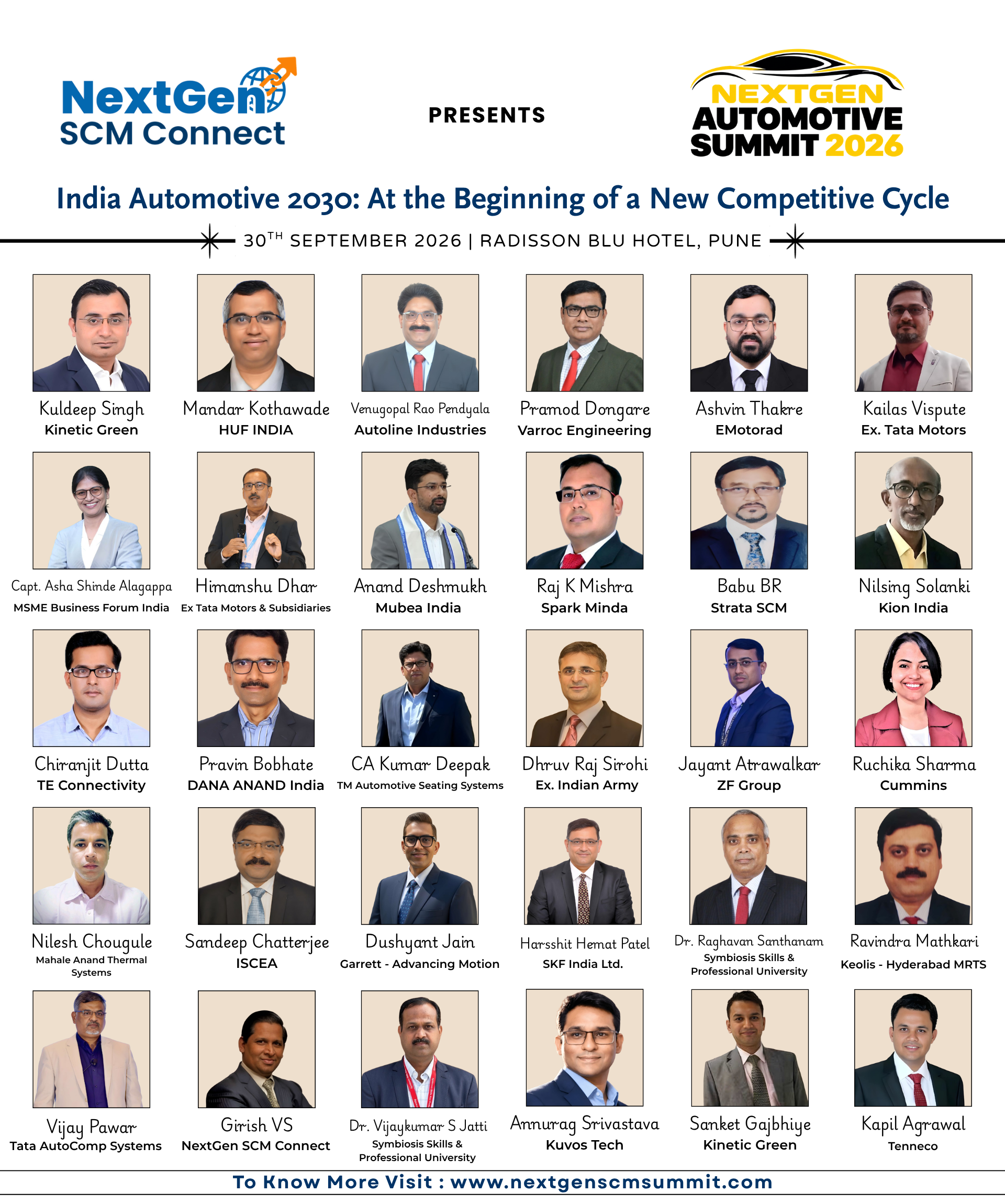
Industry leaders will meet in Pune on 30 September to discuss manufacturing, customer relationships, procurement, investment and the future of auto components
Pune, 25 September 2026: NextGen SCM Connect will host the NextGen Automotive Summit 2026 on 30 September at the Radisson Blu Hotel, Pune. The summit’s theme, India Automotive 2030: At the Beginning of a New Competitive Cycle, reflects a change in the questions facing the industry. India has established a large automotive manufacturing base and a substantial supplier network. The decisions now being made about technology, investment, skills and market access will shape how successfully that base competes through the rest of the decade.
The industry enters this period from a position of strength. According to the Society of Indian Automobile Manufacturers (SIAM), domestic passenger vehicle sales reached 46.43 lakh units in 2025–26, while two-wheeler sales reached 2.17 crore units. Passenger vehicle exports rose to 9.05 lakh units. Growth has continued into 2026–27: SIAM reported record first-quarter passenger vehicle sales of 12.74 lakh units, alongside increased two-wheeler sales and record first-quarter exports across vehicle segments.
Sales growth, however, is only one measure of the industry’s prospects. Manufacturers and suppliers are investing while the future mix of internal combustion, hybrid and electric vehicles remains uncertain. They must improve productivity and develop new capabilities in electronics, software and advanced components, while managing commodity costs and disruptions to international supply routes. SIAM has identified those cost and shipping pressures among the concerns for the sector’s current financial year.
The summit will examine these choices across five discussions. Its opening panel, “Built in India, Built for the World: Creating the Automotive Operating System of 2030,” will consider what it takes to make India a globally competitive base for manufacturing, engineering and sourcing. The conversation will move beyond localization to the ability to design, produce and export from India. It will address factory productivity, automation, quality and flexibility; the ability to operate across different vehicle technologies; and ways to build supply resilience without losing cost competitiveness. Panelists will also consider the skills needed in software, electronics, battery engineering, mechatronics and advanced manufacturing.
The second panel, “Beyond Selling Cars: Who Will Own the Automotive Customer?”, will examine the shift from the economics of a single vehicle sale to the value created throughout its life. Financing, insurance, servicing, charging, accessories, connected services and resale all influence the customer relationship. The discussion will consider the changing roles of manufacturers, dealers, digital platforms and mobility providers, including how dealers may develop as centers for customer experience, fulfilment and ongoing service. It will also address affordability and whether ownership and mobility models developed for Indian customers can succeed in other markets.
“From Cost Buying to Competitive Advantage: Reinventing Automotive Procurement for 2030” will examine the changing demands on purchasing teams and suppliers. As vehicles incorporate more electronics and software, procurement decisions increasingly affect technology access, product development, resilience and working capital. The panel will discuss sourcing across conventional, hybrid and electric vehicle programs; developing Indian suppliers to meet global standards; involving suppliers earlier in product development; and managing commodity volatility, capacity constraints and dependence on single sources. It will also consider where data and digital tools can improve sourcing decisions and provide a clearer view of risks deeper in the supplier network.
The finance panel, “The Automotive CFO’s ₹10,000 Crore Dilemma: Where Would You Put the Money Today?”, will put investment choices at the center of the conversation. Companies are being asked to fund capacity, new powertrains, batteries, electronics, software and supply security at the same time. The discussion will examine how leaders weigh investment in plants against technology and intellectual property, when an acquisition or partnership may be preferable to building a capability internally, and how much capital should be committed to resilience while demand and technology continue to change.
The final panel, “From Build-to-Print to Build-to-IP: The Reinvention of India’s Auto-Component Industry,” will look at the next stage of growth for Indian suppliers. It will consider how companies can move from manufacturing to customer specifications towards greater ownership of engineering, products and technology. Discussion areas include opportunities in EV systems, electronics, embedded software, thermal systems and advanced materials; participation in global vehicle programs; and the investment needed to strengthen smaller suppliers deeper in the industry’s value chain.
The announced speaker lineup includes Kuldeep Singh of Kinetic Green; Mandar Kothawade of HUF India; Pramod Dongare of Varroc Engineering; Ashvin Thakre of EMotorad; Dushyant Jain of Garrett; Raj K Mishra of Spark Minda; Anand Deshmukh of Mubea India; Chiranjit Dutta of TE Connectivity; Ruchika Sharma of Cummins; CA Kumar Deepak of TM Automotive Seating Systems; Nilesh Chougule and Jayant Atrawalkar of ZF Group; and Dr. Vijaykumar S Jatti of Symbiosis Skills and Professional University, among other participants. Girish V S, CEO of NextGen SCM Connect, will participate in the program and moderate discussions.
The summit will close with the NextGen SCM Recognitions 2026, at which leaders from the automotive industry will be felicitated for their contributions.
Program details are available at www.nextgenscmsummit.com.
About NextGen SCM Connect NextGen SCM Connect brings industry leaders and practitioners together through forums and knowledge programs focused on supply chain and enterprise performance.